






Gold fundamentals
Does removing a gold bar from its assay card lower its value?
Opening a gold bar’s assay card costs you something, but how much depends on bar size and how you sell. We priced carded and uncarded bars side by side.
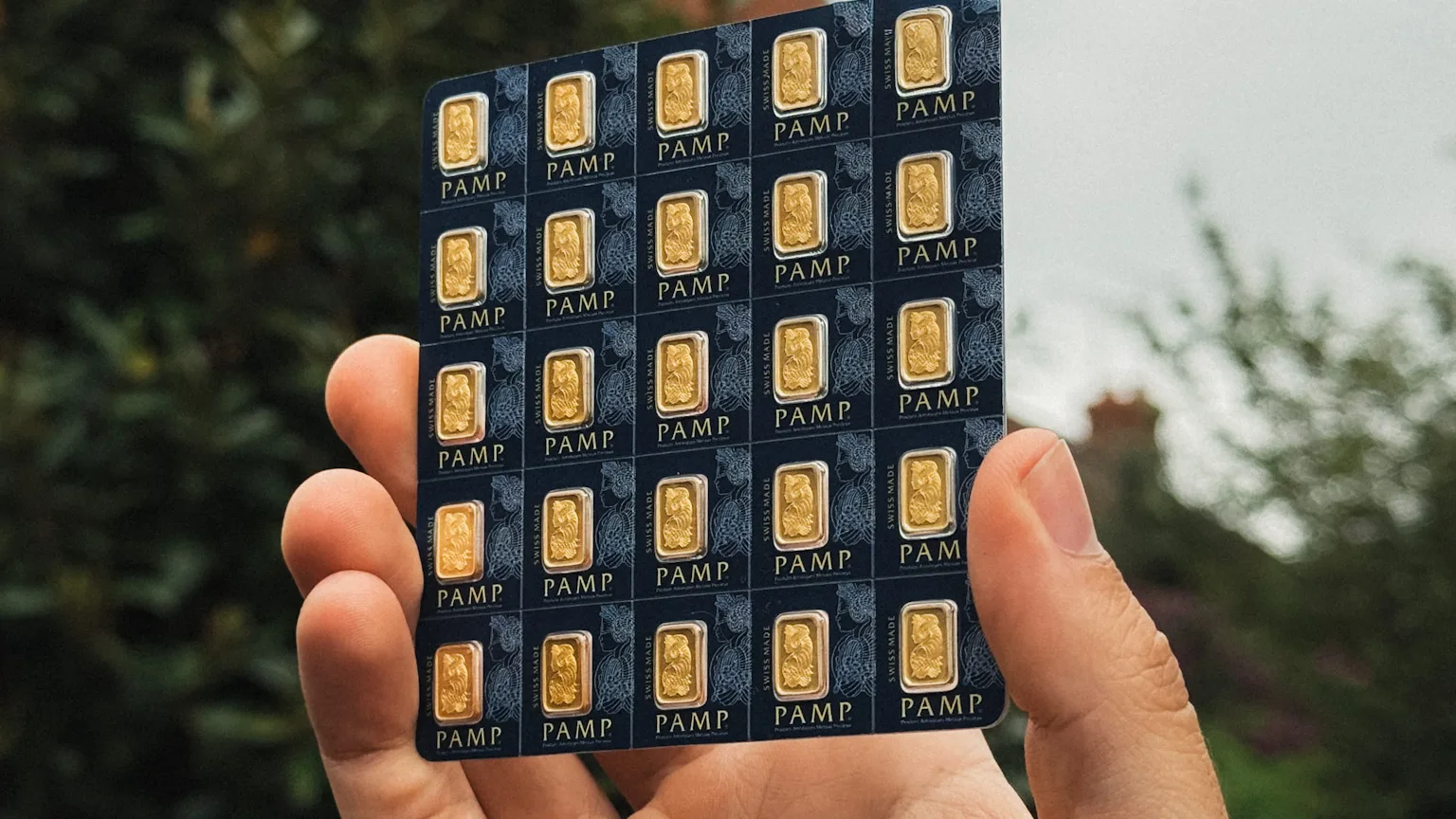
Almost every guide to gold bars ends with the same line: keep it sealed. Very few say what breaking the seal actually costs.
Part of the reason is that “value” hides three different numbers, and they behave differently.
The metal value. Unchanged. A bar out of its card weighs the same and is the same fineness. Nothing about the gold is affected.
The retail price difference between carded and uncarded products. Measurable, and we have measured it below. On a 1 gram bar the gap ran to about 13%. On a 1 ounce bar it was under 1%.
The resale loss on a bar you already own and then open. This is the number most people are actually asking about, and it is not the same as the second one. It depends on bar size, refiner, condition, and whether you sell to a dealer or a private buyer. Our retail comparison does not measure it, and this article is explicit about where the evidence runs out.
If you only read one paragraph: the gold does not change, the retail gap is real but shrinks fast as bars get bigger, and the resale hit on an already-owned bar is probably smaller than the retail gap suggests, particularly at a dealer.
Why you should be sceptical of us
We make cases that hold gold bars and coins so they can be worn. Our product only makes sense to somebody who has taken a bar out of its card. We therefore have a direct commercial interest in you concluding that opening one is no big deal.
So read this the way you would read anything written by an interested party. Every price below is a public dealer listing with the dealer, date and spot price recorded, so you can check it. Where the honest answer is bad for us, it is in here. On gram bars specifically, the card carries real value in a private sale, and we say so twice.
We do not sell gold.
What happens if you remove a gold bar from its assay card
- The gold does not change. Same weight, same fineness, same metal value.
- The original tamper evidence is gone for good. There is no way to restore it.
- The resale premium may change, by an amount that depends on size, refiner, condition and buyer.
- Authentication moves to the buyer, who now has to satisfy themselves rather than read a seal.
What an assay card actually certifies
An assay card is a sealed, tamper-evident holder. Printed on it are the refiner’s name, the bar’s weight, its fineness, and a serial number matching the metal inside.
On most modern minted bullion bars, that information is also stamped into the bar. Not on all of them. Some smaller bars and some older production carry no serial, and practice varies between refiners. But on the mainstream products this article is about, much of what the card says is also readable off the metal.
What the card adds is a claim the metal cannot make about itself: that this specific piece of gold has not been swapped since it left the refinery. That is the part that dies when you open it. Specifications can be re-established later by weighing, measuring and testing. A broken seal cannot be un-broken.
What the card does not settle
It is a certificate of the refiner’s specifications and production controls. That is not quite the same as evidence that your individual bar went through a separate metallurgical assay, and it is worth not overstating what the document proves.
At a refinery or melt buyer, weight and fineness generally matter far more than the original retail packaging.
And it is not proof against the thing most people worry about. Counterfeit bars now turn up in high-quality packaging that closely imitates the real thing, which makes inspecting the card by eye an unreliable test on its own.
What the retail gap looks like
To get a usable figure you want two versions of the same bar, from the same dealer, differing as far as possible only in packaging.
Bullion.com sells that pairing in gram sizes and describes it as such. Its carded 1 gram listing points buyers who want the same gold content without assay packaging toward the uncarded version, same random-design line, mint determined by inventory in both cases. That vendor-stated equivalence is what makes the comparison worth running at all.
Figures recorded with gold spot at $4,450.60 per troy ounce, using the dealer’s cash and wire price at single-unit quantity. One gram of gold at that spot price holds $143.09 of metal.
1 gram
| Ask price | Premium over melt | |
|---|---|---|
| Random-design 1 g, no assay card | $162.08 | $18.99 (13.3%) |
| Random-design 1 g, with assay card | $183.08 | $39.99 (27.9%) |
| Observed difference | $21.00 |
1 ounce
| Ask price | |
|---|---|
| 1 oz Random Design, no assay card | $4,691.09 |
| 1 oz Random Design, with assay card | $4,727.09 |
| Observed difference | $36.00 (0.77%) |
What that 13% is not
The dealer charges about 13% more for the carded gram bar. That is a fact about two prices on a shop page. It does not mean that opening a gram bar you already own destroys 13% of its value, and the difference between those two statements is the whole reason this article exists.
A shop’s asking price reflects what it paid, what its competitors charge, how fast the stock moves, and what the packaging costs it. What you get when you sell is set by something else entirely, covered in the next section.
A few more limits on these numbers. The ounce figures come from a different snapshot than the gram figures, so compare the ratios rather than the dollar amounts. The uncarded ounce listing is secondary-market stock the dealer notes may carry minor scratches or spotting, so part of that $36 is condition rather than packaging. And in both cases the gap contains sourcing, inventory economics and brand mix alongside the card itself. What the data supports is the direction and the rough order of magnitude.
Why the gap is proportionally larger on small bars
One likely contributor is fixed cost. Many packaging and handling costs are relatively fixed across bar sizes, and those costs get spread over very different quantities of metal. On a gram bar, fabrication and packaging are large relative to the metal value. On a kilo bar they are close to a rounding error.
That is an intuition, not a demonstration. Demand for fractional gold, secondary-market supply, wholesale sourcing and product mix all plausibly feed into the observed gap too. Treat fixed cost as one contributor among several.
The practical takeaway holds either way. The observed packaging-related premium tends to become proportionally smaller as bars get bigger, so advice written about ounce and multi-ounce bars, which is most of the advice online, does not transfer down to gram sizes.
The number we cannot yet give you
Everything above is a retail ask: what a dealer charges to sell you a bar. When you sell, you get the bid, and the bid works differently.
Commentary from bullion price-comparison sites and dealer education pages converges on two claims. Buyback spreads on liquid gold products usually sit within a few percent of spot and widen for less liquid formats. And on gram-sized bars, bids tend to land at or near spot whatever the packaging, meaning the premium is lost either way.
If that second claim holds, it changes the answer for small bars considerably: at a dealer, you would be losing the premium by having bought a gram bar at all, not by opening it.
We are not going to present that as established. It is secondhand, and it is a weaker class of evidence than the side-by-side listings above. So the honest position is this: the resale effect of opening a card cannot be quantified from the evidence we have gathered. We can show you what dealers charge. We cannot yet show you what they pay, and anyone who quotes you a confident percentage for the second number using data from the first is guessing.
Where the card more clearly does something is in a private sale. A buyer on eBay or a collector forum has no XRF gun and no test counter. Tamper-evident packaging reduces their authentication burden and raises their confidence, which is worth paying for. It does not eliminate the need to authenticate, for the counterfeit-packaging reason above. If your exit is a dealer, the card is probably worth less than the retail gap implies. If your exit is a private buyer, more.
Verifying a bar without its card
PAMP records the microscopic surface topography of each bar during production and stores it, so a registered bar can later be matched against that record. The system is called VERISCAN and works something like a fingerprint for metal.
Compatible products can be verified inside sealed packaging or outside it. For most bars the scan is done with the bar out of its packaging; scanning through sealed packaging is supported on certain larger denominations.
For a PAMP bar carrying the VERISCAN mark, then, the claim that the card is the only proof of authenticity does not hold. Check the limits before relying on it. The app is iOS only and bars made before the system existed are not in the database. Not every refiner offers an equivalent, and if yours does not, the card is doing more work.
Three things that cost more than opening the card
- Surface damage - fine gold is soft. Loose bars stored together scuff each other, and a scuffed bar reads as mishandled to a private buyer even when the weight is intact. If you open a card, the bar needs somewhere to live that is not a drawer with other bars.
- Refiner choice - recognisable, liquid refiners plausibly command stronger resale pricing than generic or unfamiliar ones, because dealers can move them faster. Choosing well at purchase probably does more for your exit price than preserving the card of an obscure bar.
- Buying gram bars at all - the carded 1 gram bar above sat 27.9% above melt. That is the real cost of holding gold in small denominations and it dwarfs everything else in this article. You pay it on the way in, whether or not you ever touch the seal.
So should you open it?
Keep it sealed if the bar is a store of value, you expect to sell it privately, and you have no reason to handle it. Sealed is the state with the most options still attached, which is why it is the sensible default.
The stakes are probably much lower than the standard advice implies if your bar is ounce-sized or larger. In our one comparison the retail gap was under 1%, and part of that was condition. That suggests the economics at ounce scale are very different from gram scale. It does not establish that opening any 1 oz bar costs under 1%, and you should check current buyback terms for your specific refiner and bar first.
Opening is a defensible trade if you plan to sell to a dealer rather than a private buyer, if your bar is surface-registered with its refiner, or if the bar is doing a job that needs it out of the plastic. Major dealers sell bezels designed to mount a bar for wear, with instructions for removing and seating it. This is an ordinary, priced decision.
What is not defensible is opening the card without knowing which of those applies to you. The seal only opens once.
Frequently asked questions
Does opening an assay card make a gold bar fake or unsellable?
No. Weight and purity are unchanged. Many bullion dealers buy genuine uncarded bars, though policies on brand, size, condition and authentication vary between them. What changes is that a buyer can no longer confirm from packaging alone that the bar was never swapped.
How much value does removing the assay card actually cost?
Three separate answers. Metal value lost: effectively nothing. Retail price difference between comparable carded and uncarded products, in the listings we checked: about $21 on a 1 gram bar and about $36 on a 1 ounce bar. Resale loss on a bar you already own and open: not established by those retail figures, and dependent on size, refiner, condition and buyer.
Can you reseal a gold bar in its original assay card?
No. The packaging is tamper-evident by design and a reseal shows. Some owners have loose bars encapsulated or graded by a third party, which creates a new record but does not restore the refiner’s seal.
Will a dealer buy a gold bar without its assay card?
Many will, and several list uncarded bars as a separate lower-premium product line. Expect the bar to be weighed and tested rather than taken at face value, and expect policies to differ between dealers.
Do gold coins have the same problem?
Less so. Sovereign coins such as Britannias, Maple Leafs and Eagles are identified by their own design, weight and dimensions and trade loose routinely, so a coin out of its tube typically carries no directly comparable assay-card penalty. Condition, capsules, original mint packaging and collector premiums can still matter a great deal for particular coins.
Is a sealed assay card proof that a bar is genuine?
It is strong evidence rather than proof. Counterfeit packaging exists and has improved. Where a refiner offers surface-based verification, that is the stronger check.
Does the assay card matter for a gold IRA?
It can. Some custodians require original packaging and certification for the bars they accept. Confirm your specific custodian’s requirement before opening anything.
Pricing recorded from Bullion.com on or before 8 September 2026, gram figures with gold spot at $4,450.60/oz, ounce figures from a separate snapshot on the same site. Buyback material is attributed commentary, not our own measurement. Authentication detail per PAMP’s VERISCAN documentation. Prices move. The ratios last longer than the dollar figures.
Assay Atelier makes cases that hold gold bars and coins so they can be worn. We do not sell gold. General information, not investment or financial advice.