






Gold fundamentals
Gold bar bezels and holders: sizes, fit and buying guide
Gold bar bezels and holders are often sold by weight, but bars of the same weight can have different dimensions. Here is what to check before buying.
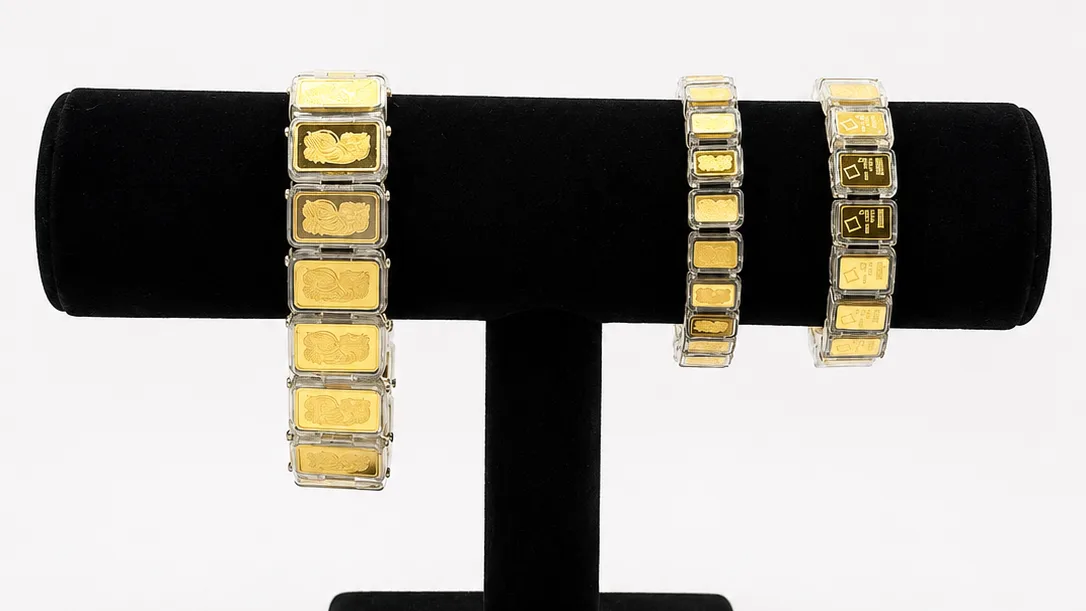
We make a wearable holder for gold bars, so we have a commercial interest in this subject. We do not rank competing holders on this page or tell you which one to buy.
Instead, this guide looks at something more basic: whether the size printed on a holder listing tells you enough to know that your gold bar will fit.
Usually, it does not.
A gold bar’s weight is not its physical size. Two bars containing the same weight of gold can have different lengths, widths and thicknesses. Products from the same refiner can also change dimensions between generations.
We document those differences in our gold bar dimensions guide. The practical consequence is simple.
A holder labelled “1 g”, “2.5 g”, “5 g” or “10 g” should not be assumed to fit every gold bar of that weight. You need the dimensions too.
What is a gold bar bezel?
A gold bar bezel is a frame that holds a small bullion bar so it can be worn, usually as a pendant.
They are sold in several forms: solid-gold frames, sterling-silver or plated frames, prong-set bezels, screw-top frames, jeweller-made and diamond-set pieces, and other wearable holders.
There are also acrylic capsules, display cases and assay-card boxes, but those solve somewhat different problems.
A bezel normally holds the bare gold bar. An assay-card box or sleeve holds the much larger sealed package around it.
That distinction matters before you buy anything.
Why the weight label is not enough
One current bezel range we examined is sold in 1 g, 2.5 g, 5 g, 10 g, 20 g, half-ounce and one-ounce sizes.
Importantly, the seller also publishes the internal dimensions and tells customers to check their bar measurements before ordering. The listing describes the range for PAMP Lady Fortuna and Credit Suisse bars.
Its published internal dimensions for the gram sizes are as follows.
| Bezel label | Published internal size |
|---|---|
| 1 g | 15.2 × 9.0 mm |
| 2.5 g | 22.25 × 13.35 mm |
| 5 g | 23.6 × 14.25 mm |
| 10 g | 26.5 × 15.8 mm |
| 20 g | 31.5 × 18.2 mm |
Source: the seller’s published product listing, checked on 8 September 2026. Linking it is not a recommendation — this page does not rank competing holders — but a figure you cannot check is not worth much.
An internal measurement can be compared with a bar. A weight label cannot.
That is what makes the table above useful. It gives numbers you can hold against the bar in your hand, which a denomination cannot do. Our gold bar dimensions guide shows why the denomination falls short.
Example: a PAMP 2.5 g bar and a 2.5 g bezel
PAMP has published its Lady Fortuna 2.5 g gold bar at 19 × 11.5 × 0.6 mm.
One caveat carries over from our dimensions guide: PAMP’s specification table is rendered in the browser rather than served in the page source, so we could not re-read that figure at this check and we treat it as pending re-verification. Every number below inherits that caveat.
The bezel listing above publishes its 2.5 g internal dimensions at 22.25 × 13.35 mm.
Subtracting the two published footprints gives 3.25 mm more overall length and 1.85 mm more overall width.
We call that the dimensional allowance: published cavity dimension minus published bar dimension.
This does not mean there is a 3.25 mm gap at one end. Nor does it prove that the bezel will or will not retain the bar securely. Prongs, positioning and construction all matter.
It tells us only that the published cavity is substantially larger than the published PAMP 2.5 g footprint.
That is precisely why “2.5 g” by itself is not a complete fit specification.
Example: why you cannot transfer a 10 g label between refiners
The problem becomes even clearer when comparing bars from another refiner.
Argor-Heraeus currently publishes its 10 g Classic gold bar at 31.5 × 18.5 × 1.0 mm.
The bezel range above publishes its 10 g cavity at 26.5 × 15.8 mm. Those published figures differ by 5.0 mm in length and 2.7 mm in width.
The next cavity in that range, labelled 20 g, is published at 31.5 × 18.2 mm. That matches the Argor-Heraeus bar’s published length but is 0.3 mm narrower than its published width.
This is not a claim that the seller has misdescribed its product. The listing is marketed for particular bar products, and Argor-Heraeus is not the product being advertised.
It demonstrates a different point. A “10 g bezel” designed around one bar format cannot automatically be treated as a universal holder for every 10 g bar.
Ten grams describes mass. It does not define a standard external footprint, and you can see the differences between refiners in our gold bar dimensions reference.
Even manufacturer dimensions need context
Published dimensions are not always described in the same way.
Perth Mint, for example, publishes its current 1 g Kangaroo bar at a length of 15.60 mm, a width of 9.10 mm and a maximum thickness of 1.30 mm.
But Perth explicitly says those figures represent the bar’s maximum possible rim thickness, length and width under manufacturing tolerances. It also says one individual bar cannot be at the maximum in every dimension.
The 1 g bezel cavity above is published at 15.2 × 9.0 mm. Perth’s published maximum footprint is therefore 0.4 mm longer and 0.1 mm wider.
That does not mean every Perth Mint 1 g bar will fail to fit. It means Perth’s published maximum specification cannot be used to confirm positive dimensional allowance against that cavity.
That difference — actual dimension, nominal specification or manufacturing maximum — is why we retain the manufacturer’s wording in our gold bar dimensions guide.
What these comparisons can and cannot tell you
The calculations on this page are deliberately simple: dimensional allowance equals published holder dimension minus published bar dimension.
But there are limits.
- The figures are published specifications, not measurements taken by us from physical products.
- A positive allowance does not prove that a bar fits securely.
- A negative allowance means the two published specifications do not fit within one another in that dimension. It does not prove what two individual physical specimens will do.
- Very small differences may also be affected by rounding and manufacturing tolerances.
And there is one particularly important dimension these comparisons often cannot check: depth. A holder can be long enough and wide enough while still being unsuitable for a particular bar thickness. If the seller does not publish internal depth, length-and-width arithmetic cannot establish full three-dimensional compatibility.
How much does a gold bar bezel cost?
There is no useful permanent price for a solid-gold bezel, because both the gold price and jewellery pricing change.
A better way to compare them is to look at material and karat, the weight of the bezel itself, construction, workmanship, any stones or other jewellery work, and retail price.
The bezel range examined above publishes, for example, a weight of about 0.89 g for its 14K prong-set 2.5 g frame.
Fourteen-karat gold is nominally 14/24 gold by weight, or about 58.3%. So 0.89 g × 14 ÷ 24 ≈ 0.52 g, which gives roughly 0.52 g of contained fine gold by nominal fineness.
You can multiply that by the current gold price per gram to get a theoretical contained-gold reference value.
Do not treat that figure as a resale estimate. A fabricated 14K jewellery item is an alloy, and the amount a scrap buyer pays can differ materially from the theoretical spot value of its contained fine gold.
What to check before buying a gold bar holder
- Measure the actual bar - check its length, width and thickness, and do not rely only on the weight printed on it. Our dimensions table can help identify published formats, but your own bar is the specimen that ultimately needs to fit.
- Ask for the internal dimensions - a listing called “5 g gold bar bezel” tells you the intended denomination. An internal length and width give you something you can actually compare.
- Ask about depth - internal depth is often harder to find than length and width. Without it, you cannot fully assess three-dimensional compatibility.
- Ask which exact bars the holder was designed for - this may be more useful than asking whether it fits “10 g bars”. Ask whether it was designed around a particular PAMP, Credit Suisse, Argor-Heraeus, Royal Mint or other product.
- Check the product generation - the same refiner can publish different dimensions for the same denomination at different times. The Royal Mint examples in our dimensions guide demonstrate this directly.
- Decide whether the bar stays in its assay packaging - a bare bar and a sealed assay card are entirely different sizes. If you do not want to remove the bar from its packaging, make sure you are shopping for a holder designed for the complete package.
- Check the return policy - this is particularly important for custom, made-to-size and jewellery products.
If you do plan to take the bar out, our assay card article covers what that does to its value.
Frequently asked questions
Will any 2.5 g bezel fit any 2.5 g gold bar?
No such assumption is safe from the weight alone. A bar’s denomination gives its weight, not a universal length, width and thickness. Compare your actual bar with the holder’s internal dimensions.
Are all 1 g gold bars the same size?
No. Argor-Heraeus, The Royal Mint and Perth Mint publish different dimensions or dimensional specifications for 1 g products. See our 1 g gold bar dimensions comparison.
Are all 10 g gold bars the same size?
No. Argor-Heraeus currently publishes its 10 g Classic at 31.5 × 18.5 × 1.0 mm, and other 10 g bars use different footprints — the Royal Mint alone publishes two, at 25.7 × 15.7 mm for the current Britannia 10 g bar and 25.5 × 15.5 mm for the superseded one.
Can I put a carded gold bar in a bezel?
Not unless the holder is specifically designed for the complete card or blister. Most traditional bezels are sized around the bare bar, while assay packaging is much larger.
Do gold bar bezels damage the bar?
Different designs contact and retain bars differently. We have not conducted comparative abrasion or long-term wear testing on the bezels discussed here, so we do not make claims about how much marking a particular design may cause.
Which gold bar holder should I buy?
We make a wearable gold-bar holder ourselves, so we do not rank competing products here. Instead, check the actual bar dimensions, holder dimensions and depth, intended bar models and return terms before buying.
About this data
Bar dimensions used in this article come from manufacturer specifications and are documented, with links and dates, in our gold bar dimensions reference.
The bezel dimensions come from the seller’s published listing and were checked on 8 September 2026. Linking that listing is not an endorsement of the product; this page does not rank competing holders.
These comparisons are arithmetic on published specifications. We have not physically tested the third-party holders discussed here.
Where relevant, we preserve qualifications such as maximum rather than treating every published number as the measurement of an individual specimen.
Product specifications and listings can change. If exact physical fit matters, check the original source and measure the bar in your possession before ordering.
Assay Atelier makes cases that hold gold bars and coins so they can be worn. We do not sell gold, and we do not sell the bezels discussed on this page. General information, not investment or financial advice.
Last checked: 8 September 2026.